From Farm to Your Kitchen: How Many Hands Does Your Egg Pass Through?
1
0
Ever wondered how an egg travels before it reaches your breakfast table?
You pick up a tray of eggs from a shop, bring it home, and crack one open. Simple enough. But that egg may have already travelled through several hands and different locations before reaching you.
Farm. Middleman. Wholesaler. Trader or distributor. Shop. Then your home.
That is the traditional route shown above.
At Brown Basket, we wanted to make that journey simpler. Instead of adding several layers between the farm and the customer, our aim is to keep the route closer to farm → quality check → packing → your home.
So what difference can the journey make? And why does it matter when you're buying something as simple as eggs?
Let's look at what actually happens between the farm and your kitchen.
The Journey Most Eggs Take Before Reaching Your Home
Egg supply chains can be very different depending on the producer, market and distribution system. Some eggs move through a relatively simple route, while others can pass through several stages before reaching the consumer.
A longer route can look something like this:
Farm → Middleman → Wholesaler → Trader/Distributor → Shop/Mart → Your Home
Every stage can involve transportation, handling and storage.
That doesn't automatically make an egg poor quality. But it does mean there are more stages to manage before the egg reaches the customer.
And when you're buying fresh food, time and handling matter.
Why Does the Egg's Journey Matter?
An eggshell may look tough, but an egg is still a delicate food product.
Proper packaging helps protect eggs from damage, moisture loss, contamination and the effects of handling and transportation. The longer an egg travels, the more important proper handling and storage become.
Temperature matters too. Eggs exposed to unsuitable temperatures can lose quality more quickly, which is why proper storage and transportation are an important part of maintaining freshness.
So when we talk about farm fresh eggs, it's worth looking beyond the words on the label.
Ask a simple question:
How does the egg actually get from the farm to me?
The Brown Basket Route: Fewer Stops, More Control
This is where our approach is different.
At Brown Basket, we aim to keep the journey straightforward:
Our Farm → Quality Check → Packing → Your Home
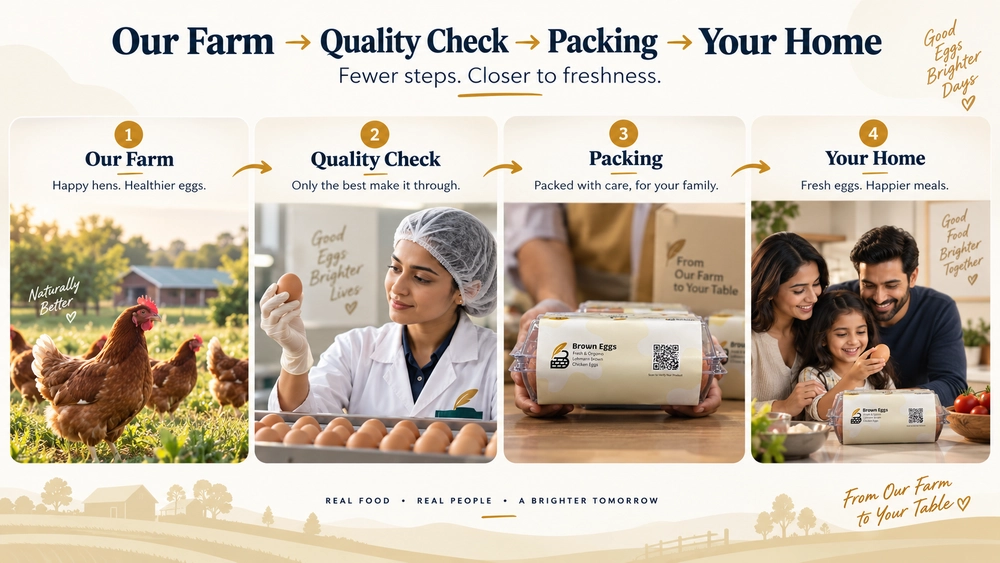
There isn't a chain of several independent stops between the farm and the customer in the route we have designed.
Once the eggs leave the farm, they go through our quality checking process. They are then packed and prepared for delivery.
The goal is simple: keep the distance and number of handoffs between the farm and your kitchen as low as practical.
This gives us greater visibility over the journey and helps us stay closer to the product from collection to delivery.
Step 1: It Starts at the Farm
Every Brown Basket egg starts its journey at our farm.
That's where the hens are kept, fed and monitored, and where the eggs are produced.
For us, being connected to the source matters because we don't want the farm to feel like a distant part of the story.
It's where the story actually begins.
Step 2: Quality Check
Before the eggs are packed for customers, they go through a quality check.
This is an important part of the process because we're not simply moving eggs from one place to another. We want to check the product before it continues on its journey.
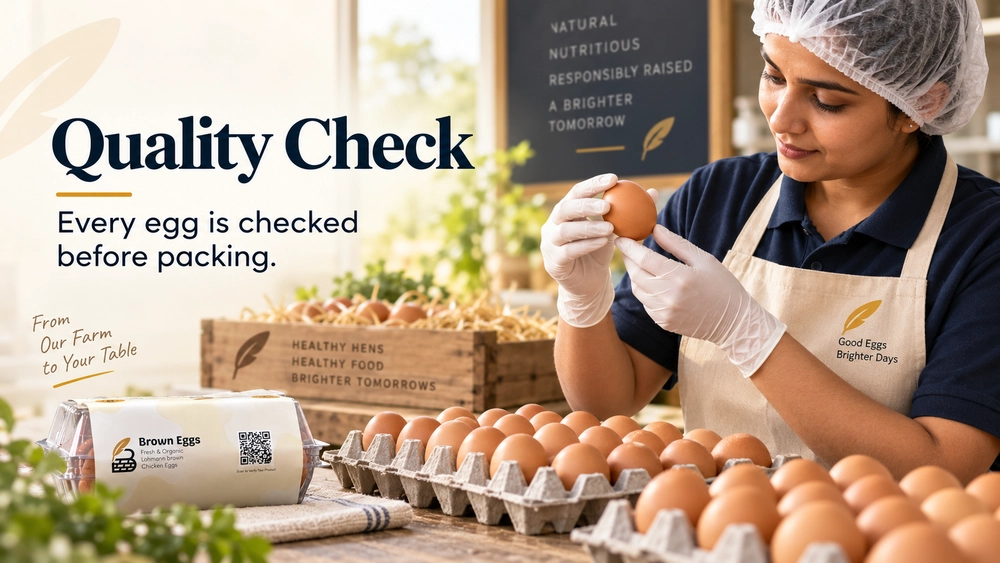
Egg quality is influenced by several factors, including breed, feed, management, disease control, collection and handling.
Step 3: Careful Packing
Eggs need protection while they're being transported.
The shell is the egg's natural packaging, but it can still be damaged by rough handling, vibration or pressure. Proper egg packaging is designed to reduce the risk of mechanical damage during storage and transportation.
That's why packing isn't just about making the eggs look presentable.
It's about helping them make the journey safely.
Step 4: From Packing to Your Home
Once the eggs are packed, they move towards the customer.
This is the part of the journey we wanted to simplify the most.
Instead of:
Farm → Middleman → Wholesaler → Trader → Shop → Home
our direct model aims for:
Farm → Quality Check → Packing → Home
It's a much easier journey to understand.
And for the customer, there's something valuable about knowing where the eggs came from and how they reached the kitchen.
Does "Direct From Farm" Always Mean Fresher?
Not necessarily.
Simply calling something "farm fresh" doesn't guarantee freshness. Freshness depends on what happens after the egg is produced, including collection, handling, transportation, storage and temperature.
That's why we prefer to talk about the journey, rather than making a blanket promise.
A shorter supply chain can reduce the number of handoffs and make the process easier to monitor. But every stage still needs to be handled properly.
That's the part that matters.
Why We Want Customers to See the Journey
Most customers never see what happens before an egg reaches a shop shelf.
They see the carton.
We think they deserve to understand the journey behind it too.
That's why we created this simple farm-to-home comparison. Not to say that every shop-bought egg follows exactly the same route, but to show how different supply chains can work.
The more steps involved, the more points there are where transportation, handling and storage need to be managed.
A direct route gives us a simpler process to oversee.
Farm Fresh Eggs Are About More Than a Label
"Farm fresh" has become a common phrase.
But we think it should mean more than just putting those words on a package.
It should make you ask:
Where did these eggs come from?
How were they handled?
How many stages did they go through?
How long was the journey?
Who was responsible for them along the way?
These questions are important because food transparency isn't only about what's written on the front of a package. It's also about understanding the journey behind the product.
From Our Farm to Your Breakfast Table
At Brown Basket, we can't control every part of what happens after an order reaches your home. But we can control the part of the journey that comes before it.
That's why we've chosen a simpler route:
Our Farm → Quality Check → Packing → Your Home
Fewer stops. Fewer handoffs. A shorter journey.
And most importantly, a closer connection between the farm where your eggs begin and the home where you enjoy them.
Because when you're buying fresh food, knowing where it comes from is only half the story. Knowing how it gets to you matters too.
Related Posts
More helpful reads to keep your kitchen healthier and your choices smarter.